
Abstract
This thesis presents a multiphysics analysis of water transport and potential water loss in Proton Exchange Membrane water electrolyzers using COMSOL Multiphysics. The study focuses on the water carried through the membrane towards the hydrogen side of the electrolyzer and subsequently discharged as part of the humid hydrogen stream.
The model combines electrochemical reactions, current distribution, multicomponent species transport, free and porous media flow, and membrane water transport. Electroosmotic drag and pressure-driven transport through a Nafion membrane are evaluated under representative operating conditions. The results show that membrane crossover can represent a relevant fraction of the theoretical water consumption required for hydrogen production.
Objectives
The main objective of this work is to quantify the amount of high-purity water that can cross the proton exchange membrane and leave a PEM electrolyzer through the humid hydrogen stream.
The study also aims to determine how water transport is affected by cell voltage, current density, anode water velocity and electroosmotic drag. A further objective is to identify the physical parameters that must be accurately defined when modelling water management and resource efficiency in PEM electrolyzers.
Methodology
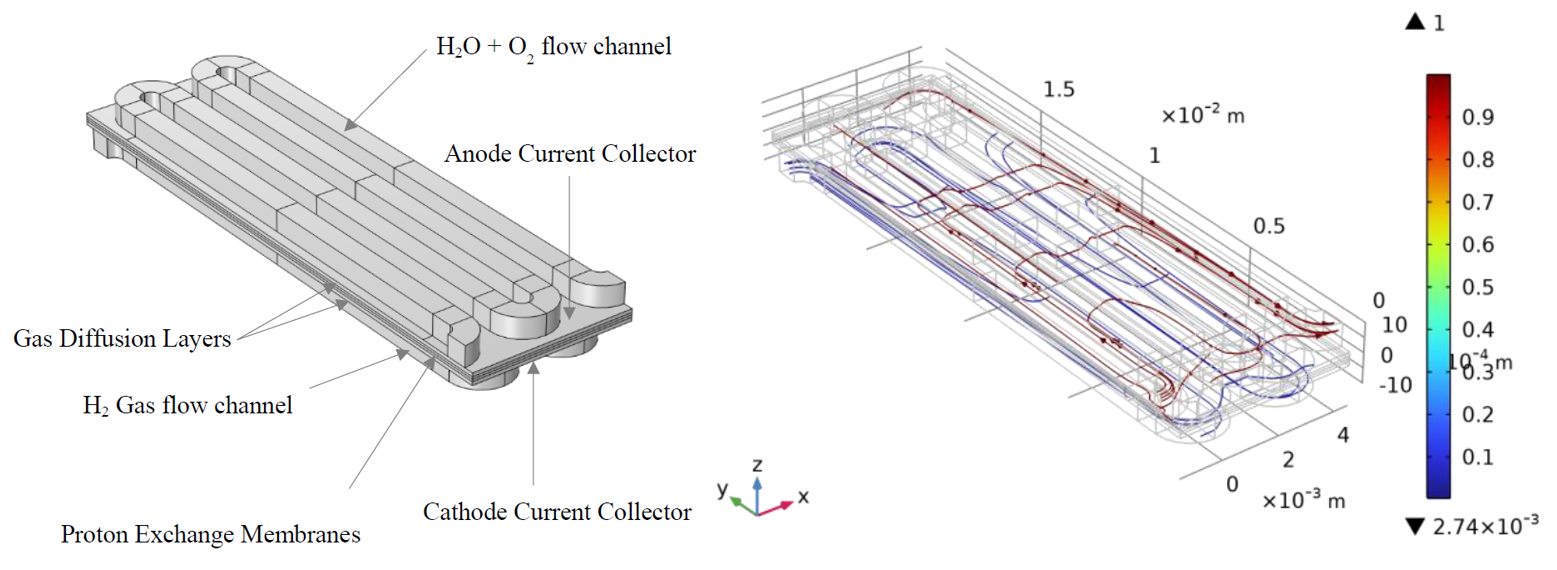
A parameterized PEM water electrolyzer model was developed in COMSOL Multiphysics using the Fuel Cell and Electrolyzer Module. The geometry included gas flow channels, current collectors, porous transport and gas diffusion layers, thin catalyst layers and a Nafion proton exchange membrane.
The Water Electrolyzer interface was coupled with Free and Porous Media Flow interfaces on the anode and cathode sides. Electrochemical reactions were described using Butler–Volmer kinetics, while multicomponent gas transport was represented with Maxwell–Stefan diffusion. Water transport through the membrane included electroosmotic drag, chemical-potential gradients, pressure effects and absorption–desorption at the membrane–gas interface.
Four simulation cases were compared, considering different combinations of velocity fields and membrane water crossover. Stationary studies were carried out using a cell-voltage sweep from 1.3 V to 2.2 V, and the results were compared with available experimental polarization data.
Results
The simulations showed that transport phenomena have a significant influence on the polarization behaviour of the PEM electrolyzer. Including the velocity fields in the flow channels and porous layers improved the agreement between the numerical polarization curve and the available experimental data.
Electroosmotic water drag had only a limited effect on the overall polarization curve, but it strongly influenced the water activity at the membrane surface on the hydrogen side. The predicted water activity increased substantially when membrane water crossover was included.
The water flux towards the cathode increased with cell voltage, current density and anode water inlet velocity. At approximately 2.2 V and 2.4 A/cm², the detailed results estimate a crossover rate of approximately 0.0035 g/(cm²·min). This represents approximately 26% of the theoretical stoichiometric water consumption at the same current density, although it remains a much smaller fraction of the total water supplied to the anode because industrial systems normally operate with a large excess water flow.
Conclusions
This thesis demonstrates that water crossover through the membrane can be an important water-management mechanism in PEM electrolyzers. Although the amount lost through the hydrogen stream may appear small compared with the total anode inlet flow, it can represent a substantial fraction of the water theoretically consumed by the electrochemical reaction.
The results indicate that membrane water transport is controlled not only by electroosmotic drag but also by pressure, species transport, flow conditions and the properties of the porous transport layers. Accurate characterization of these transport properties is therefore essential for realistic PEM electrolyzer simulations.
Recovering and treating the water carried by humid hydrogen streams could improve the efficiency of high-purity water use in green hydrogen production. Future studies should include temperature gradients, phase change, higher differential pressures, gas bubbling, turbulent effects and operation at current densities above 4 A/cm².