
Abstract
This thesis presents an inverse finite element methodology for identifying the frequency-dependent mechanical properties of a polypropylene loudspeaker cone. The study focuses on the Young’s modulus and isotropic loss factor, which determine the stiffness and damping of the cone and strongly influence its behaviour above the break-up frequency.
A two-dimensional axisymmetric vibroacoustic model of a 200 mm woofer was developed in COMSOL Multiphysics. Solid Mechanics and Pressure Acoustics were coupled through an acoustic-structure boundary, while the electromagnetic motor was represented by a calibrated lumped electrical model. Experimental electrical impedance and on-axis sound pressure level measurements were used as optimization targets.
The identified frequency-dependent material parameters improved the agreement between the numerical model and the measured acoustic response compared with a conventional model using constant material properties.
Objectives
The main objective of this work is to identify the frequency-dependent Young’s modulus and isotropic loss factor of a polypropylene loudspeaker cone using an inverse finite element approach.
The study also aims to determine the mechanical properties of the spider and surround from electrical impedance measurements, evaluate the sensitivity of the loudspeaker response to the different material parameters, and validate the resulting model against measured on-axis sound pressure levels.
A further objective is to assess whether SPL measurements, which are more accessible than laser scanning vibrometry, can be used as a practical optimization target for loudspeaker material identification.
Methodology
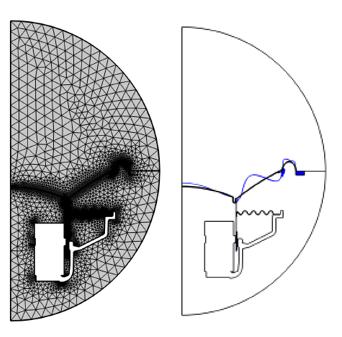
A 2D axisymmetric model of a 200 mm woofer was developed in COMSOL Multiphysics. The geometry included the cone, surround, spider, former, voice coil, glue regions and surrounding air domain.
The structural response was modelled using Solid Mechanics, while sound radiation was calculated using Pressure Acoustics in the frequency domain. Both interfaces were coupled through an acoustic-structure boundary. A perfectly matched layer was used to absorb outgoing waves, and an exterior field calculation was applied to evaluate the acoustic pressure at the experimental measurement distance.
The magnetic motor was replaced by a calibrated lumped-element electrical model based on Klippel measurements. This model included the voice-coil resistance, inductance, semi-inductance, force factor and motional back electromotive force.
The identification was performed in two stages. First, the stiffness and damping of the spider and surround were determined by matching simulated eigenfrequencies and electrical impedance to experimental measurements. Second, the cone’s Young’s modulus and loss factor were optimized separately around five radial break-up modes by minimizing the difference between simulated and measured SPL. The derivative-free BOBYQA algorithm was used for the optimization.
Results
The sensitivity analysis showed that the Young’s modulus of the cone was the most influential parameter in the break-up region, followed by its isotropic loss factor. The spider and surround had a significantly smaller effect on the high-frequency response.
The low-frequency suspension parameters were successfully identified using electrical impedance and complex eigenfrequency information. The radial cone break-up modes were then isolated and used to estimate the cone properties over several frequency bands.
The optimization produced frequency-dependent stiffness and damping values that improved the agreement between the simulated and measured on-axis SPL. The model using the identified functions and reproduced the locations and amplitudes of the break-up modes more accurately than the constant-parameter model.
The study also showed that using SPL as the optimization target is feasible, although less precise than direct cone-velocity measurements because the acoustic response includes effects such as reflections, diffraction and pressure cancellation.
Conclusions
This thesis demonstrates that inverse finite element modelling can be used to identify the effective frequency-dependent properties of loudspeaker cone materials from commonly available acoustic and electrical measurements.
The results confirm that assigning constant elastic properties to a viscoelastic polypropylene cone is insufficient for accurately predicting its response in the break-up region. Introducing frequency-dependent Young’s modulus and damping significantly improves the correlation between simulation and experiment.
The proposed workflow provides a practical alternative when laser scanning vibrometry is unavailable. However, the identified values should be regarded as effective model parameters rather than intrinsic material constants, since they also absorb the influence of model simplifications and residual suspension effects.
Future work could include acoustic loading during suspension identification, additional break-up modes, frequency-dependent suspension properties, laser vibrometry validation and the extension of the model to a full 3D geometry capable of representing circumferential modes.