

This course is dedicated to reviewing the fundamentals and underlying theory of heat transfer as well as the related physics interfaces available in COMSOL Multiphysics.
It contains a general and detailed description of the concepts, methods, and tools available for modeling Heat Transfer problems, including all the necessary theoretical background.
Using the Heat Transfer Module, students will analyze heat transfer by conduction, convection and radiation. The module includes a complete set of features to investigate thermal designs and the effects of heat sources.
Students will be able to model temperature fields and heat flows through devices, components and buildings, including multiphysics effects such as the thermoelectric effect and Joule, laser, induction and microwave heating.
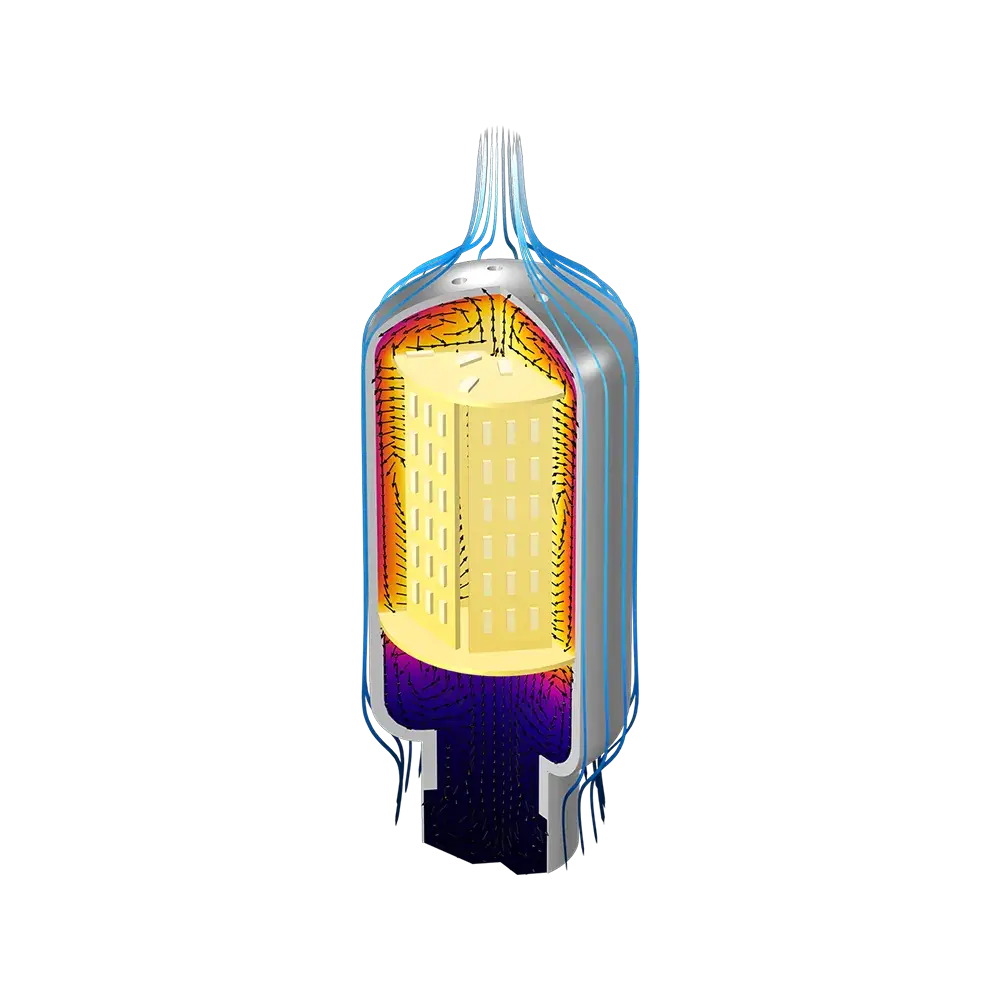
Available interfaces include Heat transfer in solids, Heat transfer in fluids, Bioheat transfer, Heat transfer in building materials, Heat transfer in moist air, surface-to-surface radiation, radiation in participating media, thin plates, thin layers and fractures.
Image made using the COMSOL Multiphysics software and provided by courtesy of COMSOL.