


The analysis of electromagnetic devices and processes in static and low-frequency cases requires powerful and flexible simulation tools.
The AC/DC Module of COMSOL Multiphysics provides modeling features and numerical methods for investigating electromagnetic fields and performing interference and electromagnetic compatibility studies by solving Maxwell’s equations.
The multiphysics capabilities of COMSOL Multiphysics make it possible to investigate the impact of other physical effects, such as heat transfer, structural deformations and acoustic interactions, within an electromagnetic model.
The course begins with the fundamental concepts and physics interfaces of electromagnetism, then implements them in multiphysics studies of devices such as capacitors, inductions, transformers, motors, actuators, cables, coils and generators.
Topics covered include electrostatics, electric currents, electric currents in shells, external electric circuits, magnetic fields, magnetic fields without currents, the Boundary Element Method, coupled electric and magnetic fields, and magnetic rotating machinery.
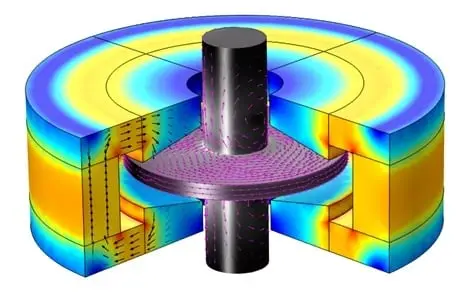
Image made using the COMSOL Multiphysics software and provided by courtesy of COMSOL.