
Battery, Fuel Cell & Electrolyzer Design

A specialized course on electrochemical energy systems, battery modeling, fuel cell operation and electrolyzer simulation workflows in COMSOL Multiphysics.

ECTS credits

4.0 ECTS

Teaching hours

13 hours

Instructor

Department of Chemical Engineering
University of Malaga
The course is taught within the Chemical Engineering & Electrochemistry track, connecting electrochemical fundamentals with practical simulation workflows.

Course overview

In this course, students study battery modeling in the first part, while fuel cells and electrolyzers are discussed in the second part.

The course starts with an introduction to battery modeling and a description of different battery types and operating principles, together with homogeneous and heterogeneous modeling levels.

Students then use the physics interfaces and tools required to model lithium-ion, lead-acid, alkaline, generic and flow batteries, with practical examples for each battery type.

The second part introduces fuel cell and electrolyzer modeling, including the Hydrogen Fuel Cell and Water Electrolyzer physics interfaces and the tools needed to model these systems step by step.
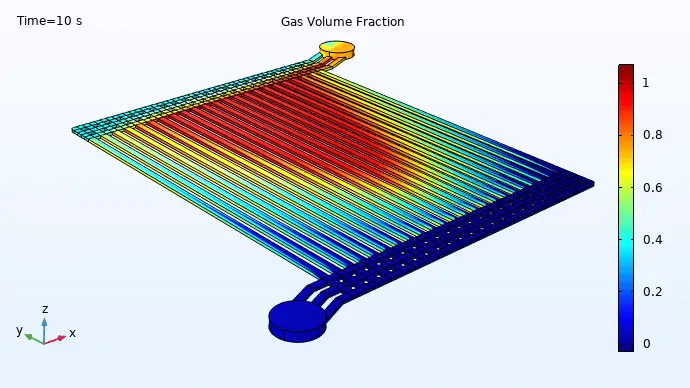
The course combines electrochemical system fundamentals with practical COMSOL workflows for batteries, hydrogen fuel cells and water electrolyzers.

Image made using the COMSOL Multiphysics software and provided by courtesy of COMSOL.

Syllabus

Module 01

Batteries

  • Introduction to battery modeling.
  • Battery types and operating principles.
  • Homogeneous and heterogeneous modeling.
  • Lithium-ion batteries and solid electrolyte interface.
  • Lead-acid, alkaline, generic and flow batteries.
Module 02

Fuel Cells & Electrolyzers

  • Introduction to fuel cell and electrolyzer modeling.
  • Fuel cell and electrolyzer types and operating principles.
  • Hydrogen Fuel Cell physics interface.
  • Water Electrolyzer physics interface.

Model electrochemical energy systems with clearer simulation foundations.

Continue reviewing the curriculum or visit the teaching team behind the program.