Particle Tracing

The Particle Tracing Module allows us to calculate the trajectory of particles in a fluid, including all interactions (particle-particle and fluid-particle). The interaction between particles and fields is bidirectional. It is possible to combine any physical interface with particle tracing to calculate the fields that drive particle motion. The motion is described by the Newtonian, Lagrangian or Hamiltonian formulations of classical mechanics, and there are multiple boundary conditions on the walls of the geometry to allow particles to freeze, stick, bounce, disappear or diffusely reflect.

We can also include the generation of secondary particles released when an incoming particle hits a wall, and add additional dependent variables to the model to calculate quantities such as particle mass, particle temperature or spin. A wide range of predefined forces are available to describe specifically how particles interact with fields, and it is possible to add arbitrary forces by their mathematical expression.

This course develops the theoretical foundations of particle tracing, always from the point of view of its implementation in the main COMSOL Multiphysics platform. We will describe in detail the physical interfaces of particle tracing and their multiphysics couplings, including all possible bidirectional interactions.

    • Introduction to particle tracing.
    • Mathematical particle tracing.
    • Tracing of charged particles.
    • Particle Tracing in fluid flow.
    • Multiphysics interfaces of particle tracing.
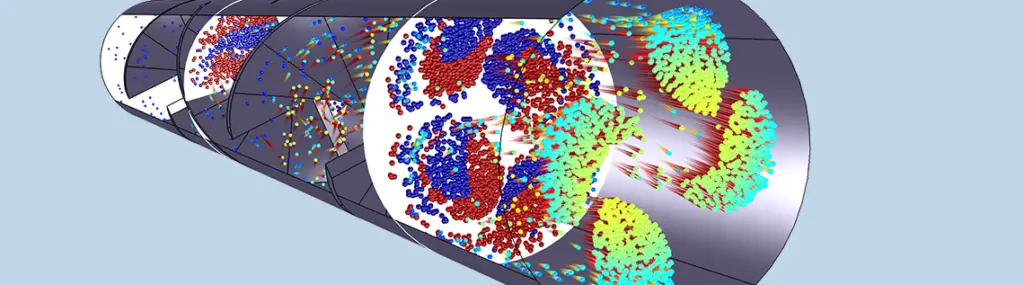
Image made using the COMSOL Multiphysics® software and provided by courtesy of COMSOL.

Particle Tracing

A specialized course on particle trajectories, particle-field interactions and COMSOL Multiphysics particle tracing interfaces.

ECTS credits

3.0 ECTS

Teaching hours

9 hours

Instructor

Department of Applied Physics II
University of Malaga
The course is taught across Electromagnetism & Optics, Chemical Engineering & Electrochemistry, and Fluid Mechanics & Heat Transfer tracks, and can also be included in a custom program.

Course overview

The Particle Tracing Module allows students to calculate the trajectory of particles in a fluid, including particle-particle and fluid-particle interactions.

The interaction between particles and fields is bidirectional, and any physical interface can be combined with particle tracing to calculate the fields that drive particle motion.

Particle motion is described by Newtonian, Lagrangian or Hamiltonian formulations of classical mechanics, with multiple wall boundary conditions that allow particles to freeze, stick, bounce, disappear or diffusely reflect.

The course develops the theoretical foundations of particle tracing from the point of view of its implementation in COMSOL Multiphysics, including physical interfaces, multiphysics couplings and bidirectional interactions.

Topics covered include mathematical particle tracing, charged particles, particle tracing in fluid flow, secondary particle generation, additional dependent variables, predefined forces, arbitrary forces and multiphysics particle-field couplings.

Image made using the COMSOL Multiphysics software and provided by courtesy of COMSOL.

Syllabus

Module 01

Particle Tracing

  • Introduction to particle tracing.
  • Mathematical particle tracing.
  • Tracing of charged particles.
  • Particle tracing in fluid flow.
  • Multiphysics interfaces of particle tracing.

Connect particle motion with fields, forces and multiphysics couplings.

Continue reviewing the curriculum or visit the teaching team behind the program.