
Abstract
This thesis presents a numerical study of an Acoustic Leaky Wave Antenna for underwater applications using COMSOL Multiphysics. The model analyses the propagation of elastic waves inside the antenna structure and their coupling with the surrounding seawater, allowing the directional radiation behaviour of the device to be evaluated.
The simulation combines Pressure Acoustics and Solid Mechanics in a coupled multiphysics framework. Key performance indicators such as radiation pattern, directivity, reflection and transmission coefficients, and radiation efficiency are analysed over a selected frequency range. The results show that the antenna can steer its acoustic beam by changing frequency, supporting its potential use in underwater localization, communication and sensing systems.
Objectives
The main objective of this work is to develop a COMSOL model capable of predicting the acoustic behaviour of an underwater Acoustic Leaky Wave Antenna.
The model is used to analyse how elastic waves propagate through the antenna structure and leak energy into the surrounding fluid, producing frequency-dependent directional radiation. A further objective is to evaluate relevant antenna performance metrics, including beam direction, directivity, reflection, transmission and radiation efficiency.
Methodology
The antenna was modelled in COMSOL Multiphysics using a 2D axisymmetric finite element approach. The geometry consisted of a periodic cylindrical waveguide made of repeated unit cells. Each unit cell included steel waveguide sections, a steel membrane and lead rings acting as leakage and support elements.
The Pressure Acoustics, Frequency Domain interface was used to model acoustic wave propagation in seawater, while the Solid Mechanics interface was used to describe the elastic behaviour of the antenna structure. Both physics were coupled using an acoustic-structure boundary condition to capture the interaction between the vibrating solid and the surrounding fluid.
A frequency-domain study was performed over the range from 7800 Hz to 9500 Hz. The model included port conditions, far-field calculations and absorbing boundary treatment to evaluate the radiated acoustic field. Postprocessing was used to extract radiation patterns, directivity maps, scattering parameters and radiation efficiency.
Results
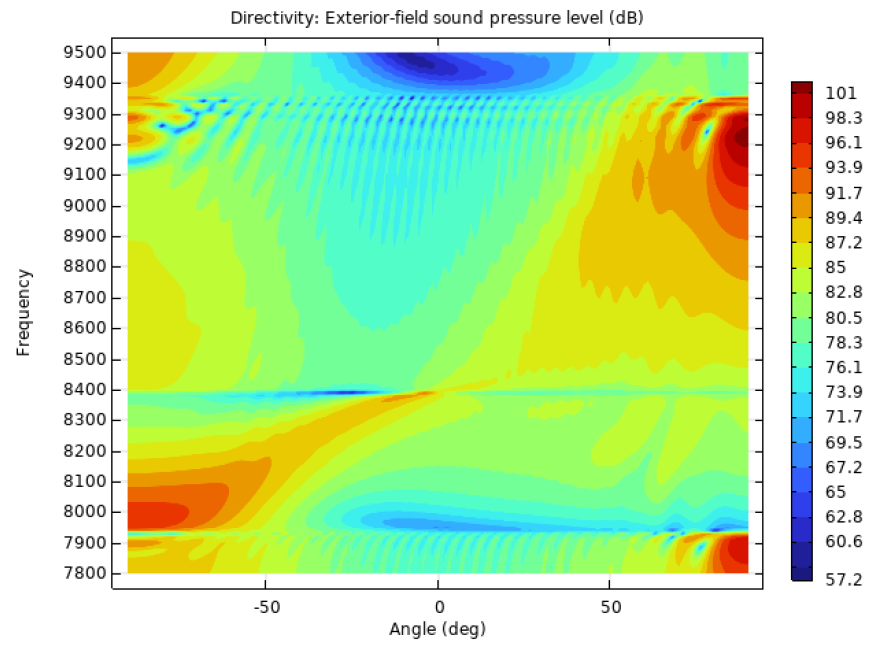
The simulations showed clear frequency-dependent beam steering, which is the characteristic behaviour of an Acoustic Leaky Wave Antenna. At lower frequencies, the antenna radiated towards negative angles, while increasing the excitation frequency shifted the main beam progressively towards positive angles.
The radiation pattern analysis confirmed that different frequencies produce different main-lobe directions and beamwidths. The directivity map showed the transition from backward radiation to forward radiation as frequency increased. Reflection and transmission coefficients also varied with frequency, revealing operating bands where acoustic energy was efficiently radiated into the surrounding fluid.
The radiation efficiency reached its most relevant values in the frequency region where transmission and radiated power were simultaneously significant, confirming the potential operating range of the antenna for underwater beam steering.
Conclusions
This thesis demonstrates that COMSOL Multiphysics is an effective tool for modelling underwater Acoustic Leaky Wave Antennas. The coupled acoustic-structure model made it possible to capture the interaction between elastic waves in the antenna and acoustic radiation in seawater.
The results confirm that the antenna can steer its acoustic beam through frequency variation, without requiring multiple active elements or mechanical motion. This makes the concept promising for compact underwater systems used in localization, communication, sensing or sonar-related applications.
The work also provides a useful numerical workflow for analysing complex acoustic metamaterial devices where analytical models are limited by geometry, material coupling and fluid-structure interaction.
Related doctoral thesis
This master’s thesis is connected with the later doctoral work by Alejandro Fernández-Garrido, Diseño y desarrollo de sistemas de comunicación acústicos submarinos basados en tecnologías de antenas inteligentes, published by Universidad Politécnica de Cartagena in 2025. The doctoral thesis extends the study of acoustic leaky wave antennas for angular steering through frequency variation, with applications in underwater communication, positioning and compact acoustic systems.