
Abstract
This project presents a general-purpose multiphysics model of a photocatalytic reactor developed in COMSOL Multiphysics. The work focuses on the simulation of a fixed-bed annular photoreactor with a TiO₂-coated catalytic surface and an axial UV light source. The model is applied to the degradation of phenol in water and is used to analyse how optical, chemical, transport and flow phenomena interact inside the reactor.
Objectives
The main objective of this work is to develop a numerical model capable of supporting the design and analysis of photocatalytic reactors. The model aims to evaluate the influence of key design and operating parameters, such as lamp power, catalyst surface concentration, inlet pollutant concentration and space velocity, on the photodegradation performance of the reactor.
Methodology
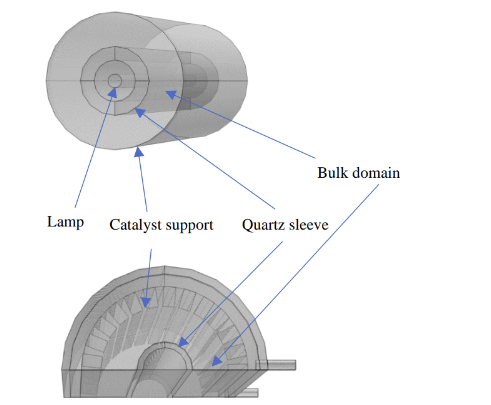
The reactor was implemented in COMSOL Multiphysics by coupling several physics interfaces, including chemical reaction engineering, transport of diluted species, laminar flow, ray optics and heat transfer. The geometry was defined as an annular reactor with a thin TiO₂ catalytic layer on the inner surface and a central radiation source. A simplified kinetic model based on the Turchi–Ollis mechanism was used to describe phenol degradation. Parametric studies were performed to evaluate the effect of lamp power, catalyst loading, inlet concentration and space velocity on the reactor performance.
Results
The simulations showed that lamp power has a direct influence on the fluence rate reaching the catalytic surface and therefore affects the degradation profile along the reactor. Phenol degradation was mainly controlled by the interaction between surface reaction kinetics and mass transport from the bulk fluid to the catalytic wall. The model showed that space velocity was one of the most influential operating parameters, with higher values significantly reducing degradation efficiency. Catalyst concentration also improved performance, although large increases were required to obtain a substantial effect. The results highlighted the importance of diffusion limitations and reactor residence time in the overall behaviour of the system.
Conclusions
This project demonstrates the potential of COMSOL Multiphysics as a tool for analysing and designing photocatalytic reactors. By coupling radiation transport, chemical kinetics, fluid flow, species transport and heat transfer, the model provides insight into the mechanisms that control reactor efficiency. The methodology can be extended to other photocatalytic systems, different pollutants and alternative reactor geometries, making it a useful framework for both teaching and engineering design applications.