
Abstract
This thesis presents the multiphysics modelling of an omnidirectional loudspeaker driver inspired by the Walsh driver concept. The study focuses on a sectorized conical membrane designed to reproduce a wide audio band while maintaining an omnidirectional radiation pattern and reducing phase issues associated with conventional multi-way loudspeaker systems.
The model was developed in COMSOL Multiphysics by coupling magnetic fields, solid mechanics and pressure acoustics. Different material combinations were tested for the membrane sectors in order to improve the frequency response, sound pressure level and mechanical behaviour of the driver. The results show that a composed membrane using paper-phenolic and aluminium layers can provide a balanced response over a significant part of the vocal frequency range.
Objectives
The main objective of this work is to analyse the behaviour of an omnidirectional Walsh-type loudspeaker driver using numerical simulation. The study aims to understand how the material properties of a sectorized membrane influence the acoustic response and mechanical wave propagation of the driver.
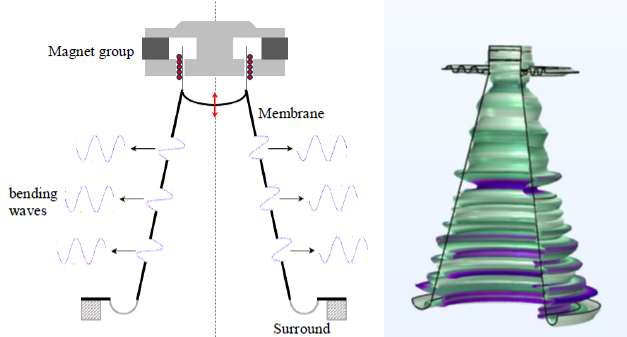
A further objective is to identify suitable combinations of membrane materials that improve the frequency response while maintaining reasonable sound pressure level sensitivity. The work also investigates the use of bending waves on a conical membrane as a mechanism for producing a coherent cylindrical wavefront.
Methodology
The loudspeaker was modelled in COMSOL Multiphysics using an axisymmetric geometry surrounded by a perfectly matched layer to represent free-field acoustic conditions. The model included the magnetic group, voice coil, former, spider, sectorized membrane, surround, enclosure and internal porous absorbing material.
Three main physics interfaces were coupled: Magnetic Fields, Solid Mechanics and Pressure Acoustics in the frequency domain. The magnetic and mechanical domains were coupled through magnetomechanics and Lorentz forces acting on the voice coil. The structural and acoustic domains were coupled using an acoustic-structure boundary condition.
Different materials were tested for the membrane sectors, including paper-phenolic, aluminium, titanium, composite, glass fibre, cloth and coated paper. The frequency response was evaluated at a point located one metre from the loudspeaker axis, and additional results were analysed through SPL distributions, mode shapes and polar radiation diagrams.
Results
The simulations showed that the material distribution in the sectorized membrane has a strong influence on the frequency response of the driver. A membrane made entirely of paper-phenolic provided better high-frequency behaviour but lacked sufficient low-frequency output, while a fully aluminium membrane improved mass loading but reduced high-frequency extension.
The best compromise was obtained by combining paper-phenolic and aluminium in different membrane sectors. This configuration produced a more balanced frequency response and improved the usable range of the driver. Additional geometric refinements, such as modifying the surround angle and improving the connection between the former and the membrane, helped reduce response irregularities and improve force transmission.
The final configuration achieved a usable response approximately within the 120 Hz to 4 kHz range, covering most of the vocal band. Mode shape results showed the transition from piston-like behaviour at low frequencies to sector decoupling and travelling bending waves at higher frequencies.
Conclusions
This thesis demonstrates that COMSOL Multiphysics is a useful tool for studying the coupled electromagnetic, mechanical and acoustic behaviour of Walsh-type omnidirectional loudspeaker drivers. The simulations show that sectorized membrane design can be used to tune the frequency response by selecting materials with different density, stiffness and thickness.
The combination of paper-phenolic and aluminium layers provided a good initial compromise between bandwidth, sensitivity and response regularity. The results suggest that this type of driver can reproduce a significant part of the vocal band without requiring crossover filtering in that sensitive frequency region.
Future work could extend the model to a full 3D simulation in order to capture non-axisymmetric membrane behaviour, circular modes and additional distortion mechanisms. Further acoustic studies could also analyse room interaction, psychoacoustic perception and the influence of omnidirectional radiation on listening environments.