
Abstract
This thesis presents the numerical modelling of a Hamlet solar concentrator using COMSOL Multiphysics. The optical system combines a Fresnel lens as the primary concentrating element with a secondary diopter based on total internal reflection to redirect and concentrate solar radiation onto a photovoltaic cell.
A digital twin of the concentrator was developed using a 2D axisymmetric geometry and the Geometrical Optics Module. Ray tracing simulations were performed using an AM1.5 solar spectrum to reproduce realistic solar illumination conditions. The model was used to analyse the optical power distribution, concentration capability and angular dependence of the radiation received by the photovoltaic cell.
Objectives
The main objective of this work is to develop a COMSOL model of the Hamlet solar concentrator and evaluate its ability to concentrate solar radiation onto a photovoltaic cell.
A further objective is to study the optical behaviour of the system by analysing ray trajectories, power distribution and the influence of the incident angle on the collected power. The model is intended to support the design and optimisation of compact optical concentrators for photovoltaic applications.
Methodology
The concentrator was modelled in COMSOL Multiphysics using a 2D axisymmetric geometry. The optical system included a TIR-based concentrator, a secondary diopter and a protective glass element. The geometry was generated using polynomial and interpolation curves to reproduce the shape of the optical components.
Poly(methyl methacrylate) was used for the TIR and secondary diopters, while EVASKY S88 glass was assigned to the protective layer. Solar illumination was represented using the AM1.5 spectral distribution, and rays were released over a wavelength range from 280 nm to 2500 nm.
The Geometrical Optics Module was used to perform ray tracing simulations. Material discontinuity boundaries were applied to model refraction and reflection according to Snell’s law and Fresnel equations. An accumulator boundary representing the photovoltaic cell was used to compute the optical power reaching the target surface.
Results
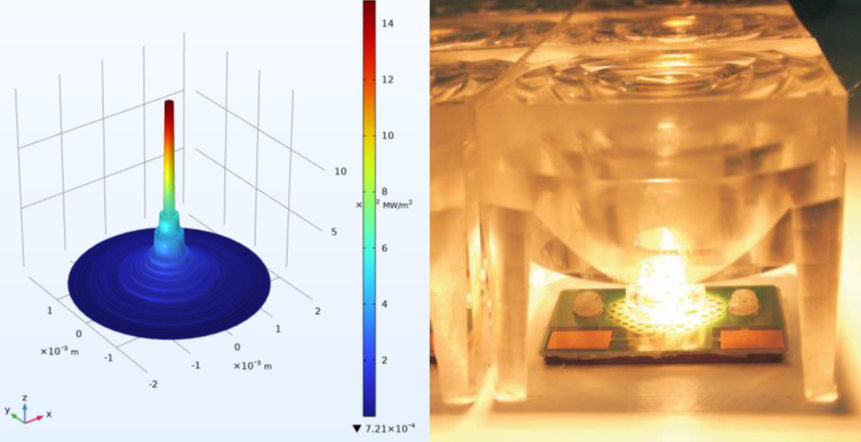
The simulations showed that the Hamlet concentrator can significantly increase the optical power delivered to the photovoltaic cell. The power distribution results demonstrated the concentration capability of the TIR diopter and showed how the incoming solar radiation is redirected towards the target region.
The angular analysis revealed that the collected power depends strongly on the incident angle of the rays. This information is relevant for defining the optimal geometry and placement of the photovoltaic cell. The model also confirmed that ray tracing in COMSOL is suitable for evaluating the performance of non-imaging optical concentrators under realistic solar illumination conditions.
Conclusions
This thesis demonstrates that the Hamlet concentrator is a promising optical configuration for increasing the irradiance received by a photovoltaic cell. The combination of Fresnel optics and total internal reflection provides an efficient and compact approach for solar concentration.
The COMSOL model made it possible to evaluate the optical behaviour of the concentrator, including power distribution and angular dependence. Although the study was limited to a 2D axisymmetric representation, the results provide a useful foundation for future work involving full 3D modelling, thermal effects and integration with advanced photovoltaic technologies.