
Abstract
This thesis presents a computational study of a multi-fuel burner concept for hydrogen and ammonia combustion using COMSOL Multiphysics. The work focuses on the development of zero-dimensional reactor models to analyse the combustion behaviour of ammonia and ammonia-hydrogen fuel blends under different operating conditions.
The model uses a continuous stirred-tank reactor approach, Arrhenius-based chemical kinetics and temperature-dependent thermodynamic properties to evaluate fuel conversion, reaction dynamics and the influence of pressure, temperature, equivalence ratio and residence time. The study provides a foundation for the future development of spatially resolved 2D and 3D burner simulations including NOx formation mechanisms.
Objectives
The main objective of this work is to develop a numerical modelling framework for analysing ammonia and hydrogen combustion in a multi-fuel burner system. The model is intended to support the design of low-carbon industrial combustion systems by evaluating the conditions required for stable and efficient fuel conversion.
A further objective is to investigate how operating parameters such as pressure, initial temperature, air-fuel ratio, reactor volume and residence time affect ammonia conversion and combustion stability. The study also aims to establish a validated modelling basis that can later be extended to include NOx chemistry, turbulent flow, heat transfer and realistic burner geometries.
Methodology
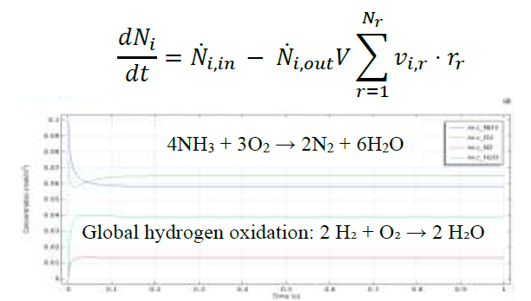
The combustion process was modelled in COMSOL Multiphysics using the Chemical Reaction Engineering Module. A zero-dimensional continuous stirred-tank reactor model was selected to represent a perfectly mixed combustion system without spatial gradients. The main species included ammonia, hydrogen, oxygen, nitrogen and water vapour.
The reactions were defined using global combustion mechanisms with Arrhenius-type kinetic expressions. Thermodynamic properties were calculated using an ideal gas mixture approach, allowing the model to account for temperature-dependent heat capacities, enthalpies and reaction heat release.
Several reactor cases were simulated by varying pressure, temperature, reactor volume, air inflow rate and equivalence ratio. The simulations were solved using time-dependent solvers suitable for stiff combustion kinetics. This staged approach allowed the chemical and thermal behaviour of the system to be analysed before moving towards more complex 2D and 3D burner models.
Results
The simulations showed that ammonia combustion is highly sensitive to temperature, pressure and residence time. High-temperature cases achieved rapid ammonia consumption and stable product formation, while lower-temperature and lower-pressure conditions showed slower reaction behaviour and greater sensitivity to reactor volume.
The comparison between different reactor models highlighted the importance of sufficient residence time for achieving higher ammonia conversion. Increasing reactor volume improved the combustion response under more challenging operating conditions. The study also showed that hydrogen addition can improve the reactivity of ammonia-based fuel blends, supporting more stable combustion behaviour.
The results also identified the limitations of the current modelling stage. NOx species were not included in the present reaction mechanism, so the model should be interpreted as a foundational combustion framework rather than a complete emissions prediction tool. Future work should include detailed NO and NO₂ pathways to evaluate pollutant formation accurately.
Conclusions
This thesis demonstrates the potential of COMSOL Multiphysics for modelling ammonia-hydrogen combustion in multi-fuel burner systems. The 0D reactor approach provides a useful first step for understanding combustion kinetics, heat release and fuel conversion before developing more computationally expensive spatial models.
The study confirms that ammonia combustion requires careful control of temperature, residence time and air-fuel ratio to achieve stable conversion. Hydrogen blending can improve combustion performance by enhancing reactivity and flame stability. The modelling framework developed in this work can be extended to 2D and 3D burner geometries, including transport phenomena, turbulence, radiation, wall heat transfer and NOx formation.
Overall, this project supports the development of cleaner industrial combustion technologies based on carbon-free fuels such as ammonia and hydrogen.