
Abstract
This thesis presents a multiphysics simulation study of an Air Motion Transformer transducer using COMSOL Multiphysics. The work investigates the acoustic radiation, vibroacoustic behaviour and electroacoustic response of an AMT by progressively developing the model from a simplified 2D acoustic representation to a full 3D coupled multiphysics model.
The model combines pressure acoustics, structural mechanics and magnetic fields to analyse how the folded foil, aluminium circuit traces and magnetic motor system influence the sound radiation of the transducer. The simulated results are compared with measurements from a real AMT unit in order to evaluate the accuracy and limitations of the numerical approach.
Objectives
The main objective of this work is to develop a numerical model capable of describing the acoustic behaviour of an Air Motion Transformer transducer. The model is used to understand how the geometry of the folded foil, the circuit traces and the magnetic field affect the directional response and sound pressure level of the device.
A further objective is to compare different levels of model complexity, from simplified acoustic models to coupled vibroacoustic and electroacoustic simulations. This allows the influence of each physical domain to be isolated and evaluated while keeping the computational cost manageable.
Methodology
The modelling workflow was developed step by step. First, a simplified 2D acoustic model was created to study the influence of foil geometry on the radiation pattern. This was then extended to a 3D acoustic model including symmetry conditions, a back chamber and absorbing material.
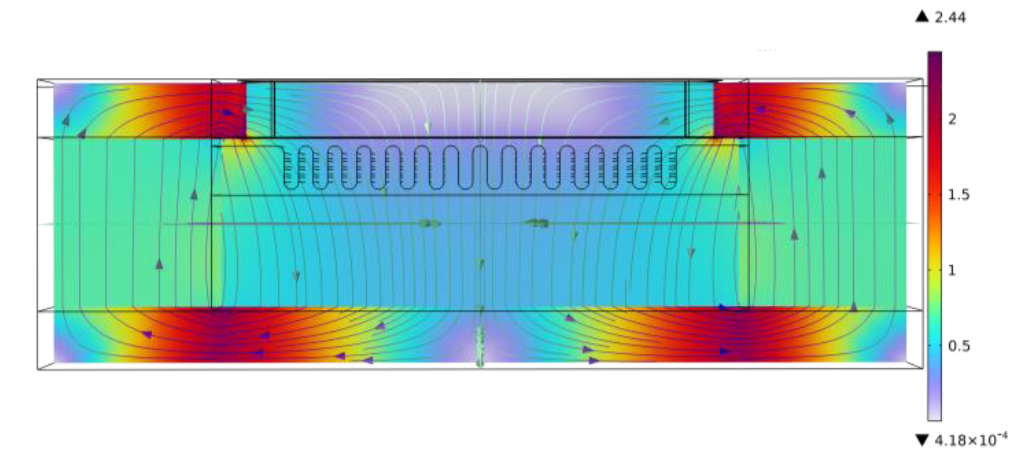
In the next stage, a structural mechanics shell interface was added to represent the thin folded foil and aluminium circuit traces. This vibroacoustic model was coupled with pressure acoustics through an acoustic-structure boundary condition. Finally, a magnetic fields interface was introduced to model the AMT motor system. The Lorentz forces generated by the interaction between the magnetic field and the electrical current in the circuit traces were used to drive the structural motion of the foil.
The simulations were performed in the frequency domain and compared with experimental measurements of a real AMT mounted on a large baffle under half-space acoustic conditions.
Results
The simplified acoustic models showed that the geometrical parameters of the folded foil have a clear influence on the directivity pattern and sound pressure level of the transducer. The 3D model made it possible to analyse both horizontal and vertical radiation behaviour.
The vibroacoustic model provided insight into the mechanical response of the foil and the influence of its eigenmodes on the acoustic output. The magnetic field simulation showed the distribution of the magnetic flux inside the motor system and allowed the estimation of the forces acting on the circuit traces.
The full electroacoustic model coupled the magnetic, structural and acoustic domains through the Lorentz force. The comparison with the real AMT showed that, despite the necessary simplifications, the numerical model reproduced the measured behaviour reasonably well, especially in the mid- and high-frequency range.
Conclusions
This thesis demonstrates that COMSOL Multiphysics can be used to analyse the complex coupled behaviour of an Air Motion Transformer transducer. The progressive modelling strategy made it possible to reduce computational cost while maintaining enough physical detail to understand the main mechanisms driving the acoustic response.
The results show that foil geometry, magnetic field distribution, structural vibration and acoustic radiation are strongly connected in AMT design. Numerical simulation can therefore support the development of these transducers by reducing the number of physical prototypes and helping engineers evaluate design parameters before manufacturing.